
7 सितंबर 2026 · लेखक Sachin Anand
Spirituality Beyond Patriarchy and Politics
Spirituality seeks freedom from limited identities; patriarchy and politics often dress social power as sacred truth. Distinguishing the two matters.
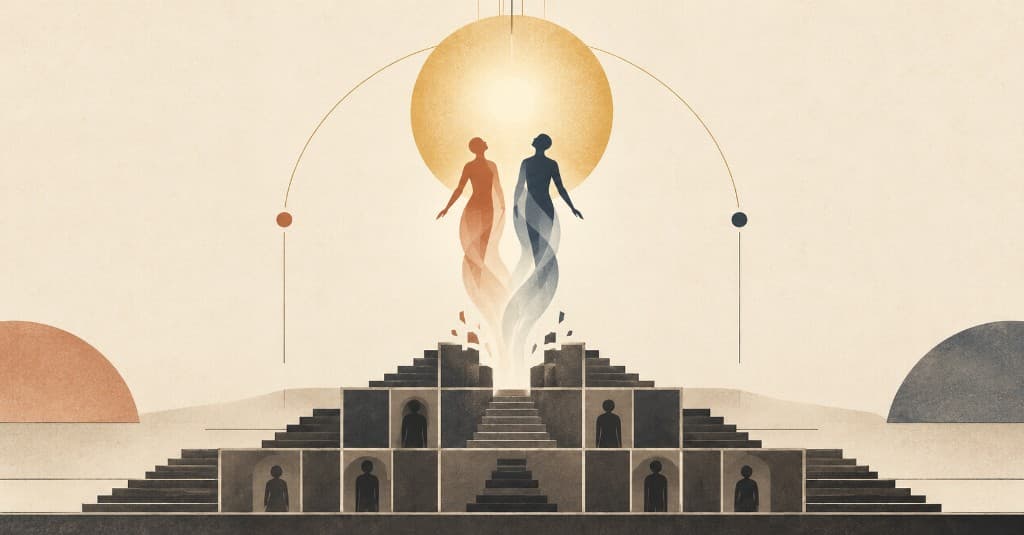
Societies across much of the world have historically been dominated by men. This influence has shaped political institutions, social customs, religious organisations, and even the ways in which spiritual ideas have been interpreted and presented.
This is particularly striking because spirituality, at its core, is concerned with transcending identification with the body and mind. In that realm, distinctions such as male and female should ultimately lose their significance. Yet organised religion and spiritual institutions have often reflected the patriarchal societies in which they developed.
Consider traditional descriptions of heaven or swarga. In many traditions, these descriptions appear to reflect predominantly male desires and perspectives, while women’s aspirations are either absent or defined in relation to men. Similarly, religious rules, commentaries, and institutional structures have historically been shaped largely by men.
Bharat is no exception. Although our traditions include remarkable women philosophers, saints, and seekers, their numbers remained relatively small. Figures such as Gargi, Maitreyi, Andal, Mirabai, Akka Mahadevi, and Lalleshwari stand out precisely because women were rarely given equal access to learning, authority, and spiritual leadership. Whenever a woman attempted to step beyond established social boundaries, she often faced intense resistance. This was not necessarily a limitation of spirituality itself; it was largely a consequence of the way society had been structured.
We must therefore distinguish between two separate domains: spirituality and social organisation.
The purpose of social organisation is to regulate collective life. It establishes roles, responsibilities, institutions, laws, and hierarchies. Because these structures are created by human beings, they are influenced by the power relations and prejudices of their time. A patriarchal society will naturally produce patriarchal rules and institutions.
Spirituality, however, has a different purpose. In its purest form, it invites a person to move beyond the limited identities of body, gender, age, status, caste, and social position. It asks the seeker to discover that which exists beyond the changing body and the restless mind.
The confusion begins when spirituality becomes intertwined with political power. Throughout history, spiritual teachings have sometimes shaped political communities, while rulers and institutions have also used religious authority to legitimise their power. As a result, social customs and political interests have frequently been presented as eternal spiritual truths.
This does not mean that spirituality can have no influence on public life. Spiritual values may inspire compassion, justice, restraint, and service. The danger arises when spirituality is used to protect hierarchy, suppress questioning, or preserve the authority of a particular group. At that point, what appears to be spirituality may actually be politics expressed in spiritual language.
A nation’s laws or customs may be patriarchal, but spirituality in its purest form cannot favour one gender over another. It cannot belong exclusively to men, the elderly, the wealthy, the educated, or any particular social group. If a spiritual system systematically privileges one section of society while restricting another, we must examine whether we are witnessing genuine spirituality or a social power structure disguised as spirituality.
Politics operates within the world of identities, institutions, competing interests, and material arrangements. Spirituality seeks freedom from excessive attachment to those very identities and arrangements. The two may interact, but they should not be confused.
In the present age, distinguishing between them is difficult but essential. We must learn to separate timeless spiritual insight from historically conditioned social rules. Only then can spirituality become what it is meant to be: a path available equally to every human being, beyond the boundaries of gender, status, and power.